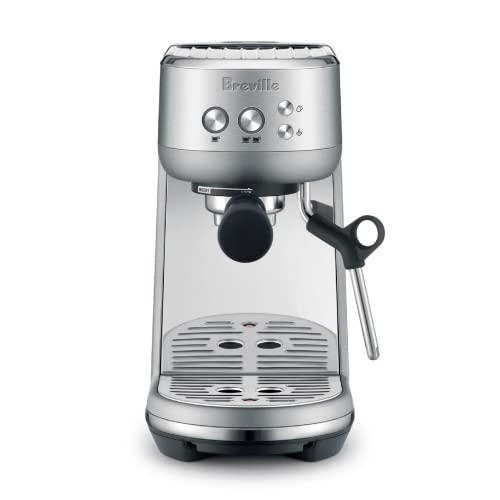
- 20-bar marketing does not mean you'll get better espresso. The advertised number is the pump's maximum capability, not the espresso pressure.
- Traditional espresso is extracted around 9 bar at the coffee puck, regardless of whether the pump is rated 15, 19, or 20 bar.
- Pressure can be regulated or limited somewhere along the path: pump, water circuit, portafilter, then the coffee puck. What happens at the puck is what matters.
- A 15-bar pump with good temperature control can outperform a 20-bar pump with weak temperature stability.
- Prioritize temperature stability, grinder quality, and basket type over a machine's peak bar rating when comparing specs.
We asked ChatGPT this exact question on Sept 26, 2026 before writing this page, specifically because bar-pressure numbers are one of the most common ways home espresso machines are marketed, and we wanted to check our own methodology against it before publishing a claim. The Breville Bambino is the real example we use throughout.
What does “20 bar” actually mean?
The pump is capable of producing up to 20 bar of pressure under certain conditions. It does not mean your coffee is extracted at 20 bar. Pressure can be regulated or limited anywhere along the path: pump, water circuit, portafilter, then the coffee puck. What matters is the pressure at the puck during the actual shot, not the pump’s peak rating on the box.
What pressure do you actually want at the coffee puck?
Traditional espresso is generally extracted around 9 bar at the coffee puck. So these marketing claims:
- “15-bar pump”
- “19-bar pump”
- “20-bar pump”
don’t mean the machine is extracting your espresso at 15, 19, or 20 bar. A machine with a 15-bar pump can make excellent espresso; a machine advertising 20 bar can also make poor espresso if its temperature control and pressure regulation aren’t good.
What matters more than the bar number?
- Temperature stability. Consistent brewing temperature matters enormously more than a pump’s peak rating.
- Pressure regulation. Can the machine actually deliver appropriate pressure during extraction, rather than simply advertising a big number?
- A good grinder. An excellent machine can’t compensate for badly ground coffee.
- A proper espresso basket. A good non-pressurized basket gives you much more control once you’re using a capable grinder.
- Heat-up time and workflow. A machine that’s ready quickly is much nicer for daily use.
Our narrow-counter head-to-head has a real example: the Breville Bambino uses a 15-bar pump but pairs it with PID temperature control, which we’d rate higher for overall brewing consistency than a machine advertising 20 bar with vague temperature and pressure specifics. The CASABREWS CM5418 advertises a 20-bar pump and includes a pressure gauge; that’s useful information to have on the machine, but it doesn’t mean its espresso is any better than the Bambino’s by default.
What is the buying rule for a bar-pressure number?
Ignore “20 bar” unless the machine also gives useful information about temperature control or pressure regulation. A 15-bar pump with good temperature control and proper pressure regulation is, in our view, a better spec sheet than a 20-bar pump with vague temperature and pressure specifics.
Is pump rating the only spec that gets marketed loosely?
The same “check what it actually measures” habit applies past bar pressure. The TIMEMORE C3S Pro advertises its burr hardness rating, and a bigger number there doesn’t automatically mean a more consistent grind, the same way a bigger bar number doesn’t automatically mean better espresso. The Breville Barista Express is sold on its “67 oz Water Tank,” and the CASABREWS 3700 Essential on its preset shot volumes, neither a bar-pressure claim, which is the kind of spec we’d rather see: something the maker can state plainly and you can verify.
Sources behind the numbers
- The 15-bar and 20-bar pump specs, and the grinder and machine specs quoted above, are sourced on this site’s narrow-counter head-to-head, budget grinder comparison and big-tank comparison, where each listing is cited directly.
Related guides
- 58mm vs 54mm portafilter: what the size actually changes
- Breville Bambino vs De’Longhi Dedica vs Casabrews CM5418 for a narrow counter
More on How to Read an Espresso Machine's Pressure Spec Before You Buy
Does 20 bar mean an espresso machine is better than a 15-bar machine?
Not by itself. 20 bar is a marketing number describing the pump's maximum capability under certain conditions, not the pressure your coffee is actually extracted at. Traditional espresso extracts around 9 bar at the puck regardless of the pump's rating.
What pressure does espresso actually extract at?
Around 9 bar at the coffee puck. A pump advertising 15, 19, or 20 bar is capable of producing up to that pressure under certain conditions; it does not mean your coffee is brewed at that pressure.
What should I check instead of the bar rating?
Temperature stability during extraction, whether the machine can actually deliver appropriate pressure rather than just advertising a big number, grinder quality (an excellent machine can't compensate for badly ground coffee), and how quickly the machine heats up.
Is a 20-bar pump ever a reason to avoid a machine?
Not by itself, but we wouldn't choose a machine because of a 20-bar pump alone, and we'd assume a machine emphasizing that number over temperature and pressure regulation specifics is using vague marketing language rather than useful information.
Spec-checked by CremaCheck spec desk · published